Amazon Barcode Rules 2026: What the March Change Means for FBA

Ekaterina Rubtcova
Amazon seller since 2018 · Founder of Daniks cookware · Founder of Daniks.AI
My Daniks cookware reached Top-1 in Germany and is currently Top-20 in the USA. To run its PPC I built Daniks.AI — now used by hundreds of Amazon brands. On this blog I share how I actually operate, no courses, no upsells.
Subscribe to our YouTube channel
Subscribe to our YouTube channel for video walkthroughs
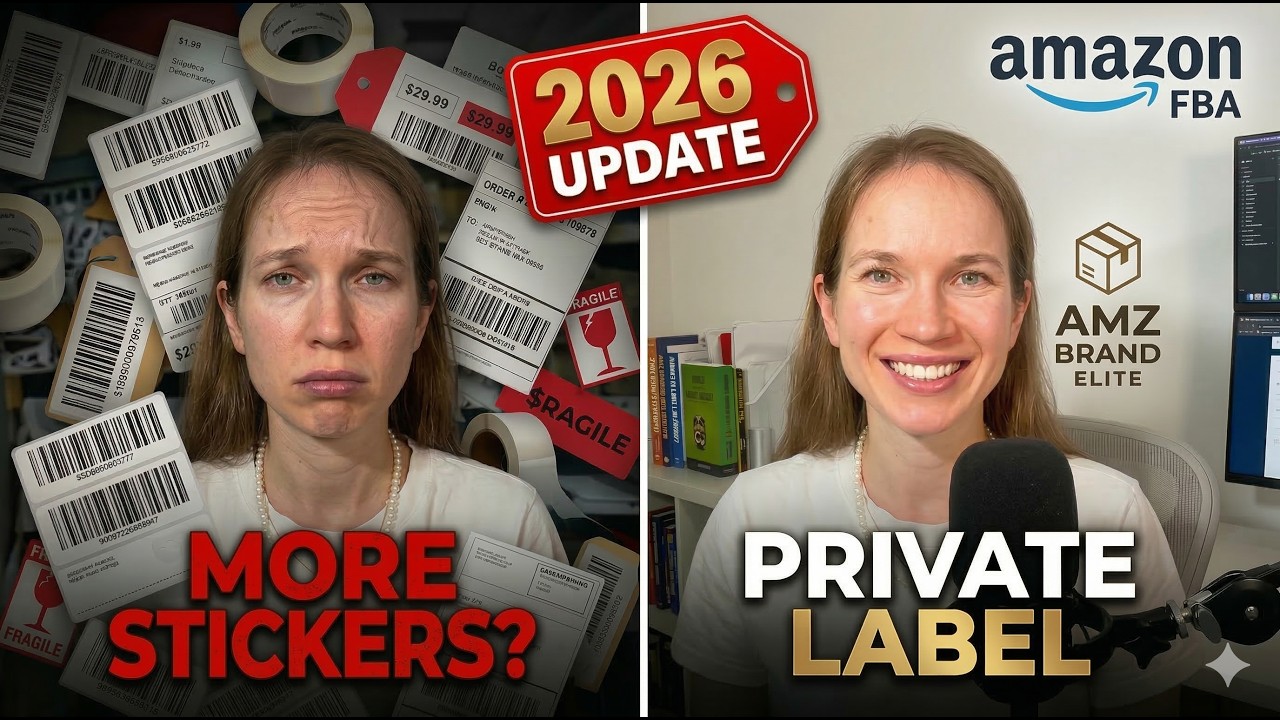
Subscribe NowThe new Amazon barcode rules took effect on March 1, 2026, and they draw a hard line through the FBA seller base. Only brand owners and their official representatives can now ship products using the manufacturer’s original barcode. Everyone else, arbitrage sellers, wholesalers, unbranded resellers, has to cover the manufacturer code with an Amazon-generated FNSKU sticker on every unit before it goes into an FBA shipment.
If you have a Brand Registry account for what you sell, nothing changes for you operationally. If you do not, your per-unit prep just got longer, and Amazon just put another reason in the “go private label” column of your business plan.
Key Takeaways
- Effective March 1, 2026: only brand owners or brand representatives can ship products to FBA with the original manufacturer barcode (UPC/EAN/GTIN) visible.
- Non-brand sellers must apply an FNSKU sticker that covers the manufacturer barcode on every single unit before inbound.
- Retail arbitrage, online arbitrage, and wholesale sellers carry the full sticker burden. Private label brand owners are unaffected.
- This accelerates the private label thesis: higher margins, no Buy Box fights, access to A+ Content and Brand Store, a real asset in two years.
- Transition plan for new sellers: start with other-brand products to learn the platform, then pivot to private label as fast as possible.
What the New Amazon Barcode Rules Actually Say
Amazon has always let sellers choose between two barcode options when shipping FBA:
- Use the manufacturer’s barcode, the UPC, EAN, or other GTIN already printed on the product packaging. Amazon scans that code on receipt.
- Use the FNSKU, a Fulfillment Network SKU Amazon generates for your specific listing. You print it on a sticker and apply it to each unit, typically covering the manufacturer barcode.
Before March 1, 2026, most sellers used the manufacturer barcode option when they could. It is faster, cheaper, and skips a labeling step. The new rules remove that choice from anyone who does not own the brand.
Specifically: only brand owners and authorized brand representatives can continue to use the manufacturer’s barcode. Every other seller, retail arbitrage, online arbitrage, wholesale, any commingled model, must apply an FNSKU sticker to every unit, covering the original code entirely.
The rule goes beyond labeling convenience. It is Amazon tightening the link between the seller and the inventory. When every unit carries an FNSKU that belongs to one specific seller’s listing, there is no ambiguity about whose unit ships to the customer. That reduces counterfeit risk, cuts down on commingling issues, and, not incidentally, pushes more sellers toward Brand Registry.
Who This Hits Hardest
The barcode change creates three clear groups:
Brand owners (no change)
If you are enrolled in Amazon Brand Registry for the brand you sell, you can continue using your manufacturer barcode on FBA shipments. Your prep workflow stays the same. This is the category that pairs best with the first product launch playbook.
Authorized brand representatives (minor change)
If you sell another brand’s products and that brand has authorized you as a representative inside Amazon’s Brand Registry portal, you are also exempt from the sticker requirement. The documentation burden is on you: you need the brand’s written authorization and you need it logged with Amazon.
Everyone else (sticker every unit)
Retail arbitrage, online arbitrage, wholesale, unbranded dropship, if you do not own the brand and are not an authorized representative, you apply an FNSKU sticker to every single inbound unit from March 1 onward. For a 500-unit RA shipment, that is 500 stickers, 500 covers over original barcodes, and a measurable time hit on your prep workflow or a measurable fee hit if you use Amazon Prep Services.
The operational cost is not small. Amazon’s own prep labeling fee runs $0.30 per unit as of 2026. A 500-unit shipment that used to skip labeling just added $150 in unavoidable cost.
Why This Is Actually Good News (If You Are Willing to Build a Brand)
My reaction when this rule dropped was: finally. The barcode change is one of the clearest nudges Amazon has ever given toward private label as the long-term sustainable model. Here are three reasons sellers should welcome it.
1. Higher margins, no Buy Box war
Private label means you own the listing. There is no Buy Box competition because there is only one seller. You are not undercut by someone dumping the same product at $0.50 below your price because there is no “same product”, there is your product. Higher margins stop being a cost-optimization game and start being a pricing decision you control. This is the same dynamic I cover in the $0.50 mistake, but applied to the listing side instead of the sourcing side.
2. Long-term asset value
A private label brand you build today is worth something in two years. A reseller listing someone else’s ASIN is not. Ask any arbitrage seller what percentage of their listings from two years ago are still generating meaningful profit. The attrition is brutal, listings get gated, brands revoke authorization, suppliers dry up, the original brand owner jumps onto the listing and undercuts everyone. None of that happens when you own the brand.
Start Brand Registry today with reasonable effort and you have an established brand in 18 to 24 months. Start reselling today and you have a monthly treadmill with no equity at the end.
3. Access to the brand toolkit
Amazon gives brand owners a toolkit that resellers cannot touch. The big ones:
- A+ Content, expanded product description with images, comparison charts, and rich media that lift conversion rates 3 to 10%.
- Brand Store, a mini-storefront on Amazon that aggregates your catalog and captures cross-sell revenue.
- Sponsored Brands and Sponsored Display, ad types tied to Brand Registry that let you defend branded terms and retarget viewers.
- Virtual Bundles, multi-product bundles created without physical packaging. The virtual bundles playbook explains this in detail.
- Brand Analytics, search term data you cannot see without Brand Registry.
Each one of those is a competitive moat. Stacked together, they are the reason a private label brand outperforms an identical reseller listing on the same product.
The Downsides of Private Label (Be Honest)
Private label is not a free lunch. Two real costs:
Time to approval. Brand Registry requires a registered trademark, which can take 6 to 12 months depending on the country and category. You can use Amazon’s IP Accelerator to speed this up, but it still adds weeks to your launch timeline. Beyond Brand Registry, you need product photography, listing copy, packaging design, and supplier negotiations, none of which are fast.
Upfront capital. Private label MOQs run 300 to 1,000 units on most categories. At a $5 landed cost, that is a $1,500 to $5,000 first order before you have sold a single unit. Compared to retail arbitrage, where you can start with $500 of clearance inventory, the capital barrier is higher.
For sellers under $5,000 in launch capital and with zero FBA experience, it still makes sense to start with other-brand products, just to learn how Seller Central works, how inbound shipments flow, how returns behave, how Amazon’s reimbursement system plays out. Use the other-brand phase as training, not as the long-term business. Transition to private label the moment you have enough capital and pattern recognition.
Action Checklist for the New Rules
Whether you are already branded or still a reseller, here is what to do this week.
If you sell as a brand owner
- Verify your Brand Registry status is active, check the Brand Registry dashboard.
- Confirm your GTIN/UPC is correctly associated with your Amazon listings.
- Note any third-party resellers on your listings and whether they are authorized representatives.
- Audit your inbound packaging to confirm the manufacturer barcode is scannable and matches the listing.
If you sell as a reseller
- Switch every active SKU to FNSKU labeling in Seller Central. Do this in the “Manage FBA inventory” → “Edit” → “Amazon barcode” workflow.
- Decide: self-prep or Amazon prep, the $0.30/unit prep fee is now a fixed cost on every RA/OA/wholesale shipment. Self-prep cuts the cost but costs you hours. Run the math on your volume.
- Review your margins on your top 20 SKUs with the new labeling cost baked in. Some thin-margin arbitrage plays no longer pencil out.
- Start your private label transition plan, if you have not already, this is the nudge. Start by picking one category where you have category expertise and run the product research playbook.
If you are brand-new to FBA
- Start with a small retail arbitrage test, 50 to 100 units of something obviously profitable, just to run the full FBA loop once. Expect to pay the $0.30 prep fee. The goal is not profit; it is pattern recognition.
- File your trademark application in parallel. The 6 to 12 month timeline starts the day you file. If you know you want to build a brand, file today and let the clock run while you learn.
- Do not sink real capital into RA/OA. Treat it as tuition.
Frequently Asked Questions
When did the new Amazon barcode rules start?
March 1, 2026. From that date, only brand owners and authorized brand representatives can ship FBA units using the manufacturer’s barcode. Every other seller must apply an FNSKU sticker that covers the manufacturer code.
Do I need to sticker every unit now?
Yes, if you do not own the brand or are not an authorized brand representative. Every unit inbound to FBA must carry an FNSKU sticker that covers the manufacturer’s UPC, EAN, or other GTIN.
What is an FNSKU?
An FNSKU (Fulfillment Network SKU) is a barcode Amazon generates for each of your listings. You print it on a label and apply it to each unit before shipping to FBA. It links the specific unit to your specific listing, removing any ambiguity from commingling.
How much does Amazon charge to apply FNSKU stickers for me?
Amazon’s FBA Label Service charges $0.30 per unit as of 2026. On a 500-unit shipment, that is $150, a new line item on every reseller inbound. Self-prep saves the fee but costs labor time.
Does Brand Registry exempt me from FNSKU stickers?
Yes. If you own the brand and are enrolled in Amazon Brand Registry, you can continue using the manufacturer’s barcode on FBA shipments. The FNSKU sticker is only required for non-brand sellers.
Should I start private label because of this rule?
If you are planning to build a long-term Amazon business, yes, the rule change reinforces that private label is the durable model. The 10 FBA mistakes beginners make includes “staying in arbitrage too long” as a core pitfall, and this rule change only sharpens the point.
The Bottom Line
Amazon did not make a small tweak on March 1. They redrew the line between resellers and brand owners, and they put a measurable operational cost on staying a reseller. For anyone committed to arbitrage or wholesale long term, the sticker requirement is now part of the baseline economics, factor $0.30 per unit into every shipment. It is not the only cost line moving this year either — if you import your inventory, the Supreme Court’s IEEPA tariff-refund ruling could change what you actually owe on landed goods.
For anyone with ambition beyond arbitrage, this is the clearest signal in years that the private label path is where Amazon wants you. Higher margins, Buy Box ownership, brand-registry tooling, and an asset worth something in two years. The barcode rules are annoying in March 2026. They are a blessing in March 2028 for the sellers who take the hint.
For the full launch playbook, start with how to launch your first Amazon product and the tools I actually use.
Related articles
Amazon Announces Major FBA Fee Changes for 2026
Breaking down the latest Amazon FBA fee structure changes and what they mean for sellers.

Amazon SP-API Paid Changes 2026: $1,400/Year, Explained
Amazon SP-API paid changes 2026 hit your tool vendors at $1,400/year. Learn which repricers, PPC tools, and dashboards will pass it to you.