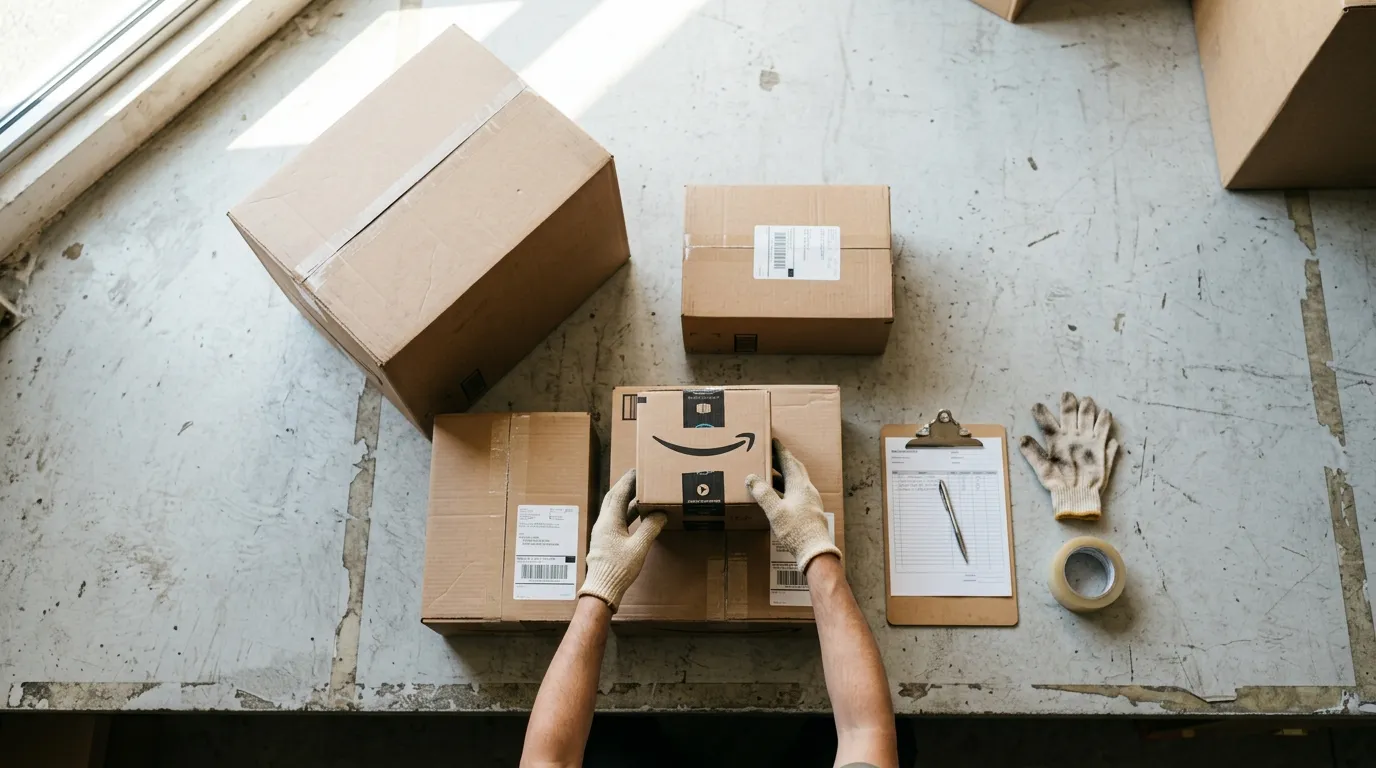
Amazon Product Research in 2026: 7 Unconventional Methods
The best Amazon product research in 2026 does not start in a Helium 10 spreadsheet. It starts in the places most sellers ignore: the Canton Fair exhibitor catalog, the AliExpress Dropshipping Center, one-star Amazon reviews, Kickstarter, Reddit threads, and subscription-box unboxing videos. Seven unconventional methods, each of them finding products the filter-first crowd will never see.
I still run Black Box and Cerebro every week. But if I only ran them, I would be looking at the same opportunities as every other seller with a Helium 10 subscription. These seven Amazon product research methods are how my friends and I find products before the tool databases catch up.
Key Takeaways
- Virtual-attend the Canton Fair by working through the exhibitor catalog and emailing suppliers directly.
- The AliExpress Dropshipping Center shows what paid social traffic is converting; your FBA warehouse beats a three-week wait from China.
- The one-star method finds categories with proven demand and fixable product flaws you can out-design.
- Kickstarter projects that hit 10x their funding goal are pre-validated demand signals.
- Reddit and subscription-box unboxings surface specific pain points no spreadsheet tool can see.
- Test five to ten products at once using small sample orders and Amazon Global Logistics, not full MOQs.
The Seven Methods at a Glance
| # | Method | What It Finds | Best For |
|---|---|---|---|
| 1 | Canton Fair exhibitor catalog | Vetted Chinese factories and MOQ data | Sourcing and price discovery |
| 2 | AliExpress Dropshipping Center | Products with rising paid-social traffic | Early-trend demand signals |
| 3 | One-star review mining | Proven categories with fixable flaws | Differentiation in saturated niches |
| 4 | The leech strategy | Accessory categories attached to hit products | Cheap traffic, higher margins |
| 5 | Kickstarter and Indiegogo | Products backers paid for pre-launch | Pre-validated novel categories |
| 6 | Reddit pain-point threads | Specific complaints in target niches | Product-design briefs |
| 7 | Subscription-box unboxings | Curated hits from brands like BarkBox, FabFitFun | Demographic-matched winners |
Why Spreadsheet-Only Product Research Misses Products
Helium 10 Black Box and Jungle Scout are extraordinary tools. I use both. But they show you what is already selling well on Amazon, which means every seller running the same filters sees the same 30 candidates.
The methods below look at signals that have not landed in Amazon databases yet. Demand on a Kickstarter campaign, a complaint pattern on Reddit, a product that drop shippers are actively promoting on TikTok. These are leading indicators. By the time Jungle Scout shows the trend, the window has narrowed.
If you want the structured filter-first approach, read the product research masterclass first. Consider the seven methods below the supplement that finds what the masterclass misses.
Method 1: Mine the Canton Fair Catalog Without Leaving Home
The Canton Fair is the largest trade fair in China. Sellers fly to Guangzhou, spend several thousand dollars on flights and hotels, and walk miles of booths to meet suppliers in person. You do not need to.
Every year, the Canton Fair publishes an exhibitor catalog with the full list of factories attending. Open it, filter by the category you care about, and you have thousands of vetted suppliers with contact details. These are factories committed enough to the export market to pay for a booth.
Sarah, a friend of mine in kitchen gadgets, works through the catalog every quarter. She sends the same email to 40–60 suppliers at a time:
“Are you the factory or a trading company? What is your MOQ on [product]? What is your current price per unit? Can we schedule a video factory tour?”
Some suppliers never reply. That is the same outcome you get walking a booth at the physical fair. The ones who do reply give her price, MOQ, and capability data in a few days, without the $4,000 travel budget. This single Amazon product research method has surfaced three of her last five product launches.
Method 2: Use the AliExpress Dropshipping Center as a Demand Radar
The AliExpress Dropshipping Center is designed for drop shippers deciding what to promote on Facebook, TikTok, and Instagram. For Amazon sellers, it is a live demand radar.
When drop shippers push paid traffic to a product, they are validating that people will click “buy” on a cold ad. The product works in social feeds. The problem for the end customer is that it ships from China, so delivery takes three weeks.
Here is where the FBA advantage kicks in. You import the same product to an Amazon fulfillment center. Your listing offers one-day Prime delivery. The customer chooses you over the drop shipper every time.
Mike was scrolling the Dropshipping Center in early 2024 when he noticed a silicone pet grooming glove with rising paid-traffic volume. Helium 10 did not flag it yet; the US Amazon demand had not caught up. He placed a small sample order, built a listing, and rode the wave as the keyword search volume climbed for the next four months. That is the leading-indicator angle the filter tools cannot match.
Method 3: Run the One-Star Review Method on Proven Categories
Most product research advice tells you to find listings with excellent reviews. That signals the existing product is good. What you actually want is a category with proven demand and poor execution, because that gap is where your improved version lives.
Here is the one-star method. Pick a category that sells well. Top listings should have strong monthly revenue but average ratings below 4.2 stars. Open the one-, two-, and three-star reviews. Paste them into your AI tool of choice and ask for a frequency analysis of the complaints.
You will see the same phrases repeat:
- The handle keeps breaking off.
- The lid gets dangerously hot.
- The seams come unglued after a month.
- The battery dies in two weeks.
Each complaint is a design brief. Customers are telling you exactly what your version needs to fix. Send the complaint list to your supplier as your product specification. You have just turned other sellers’ negative reviews into your product-development roadmap.
This method also solves the biggest beginner trap I cover in the 10 Amazon FBA mistakes for 2026 article: launching into saturated niches without a clear differentiator. Fixing a named complaint is a differentiator.
Method 4: Sell Accessories to Popular Products (The Leech Strategy)
Some products are so well-marketed by someone else that you would be insane to compete with them directly. iPhones are the canonical example. Apple spends billions convincing people the iPhone is worth $1,200.
The leech strategy says this: do not try to sell the iPhone. Sell the accessories. Cases, cables, docks, lens kits, screen protectors. These products latch onto iPhone traffic without paying for iPhone marketing. Every iPhone keyword search drips volume down to accessory listings.
Accessory categories carry two structural advantages. First, margins are usually higher because customers compare within a narrower price band. Second, traffic is effectively free. Someone else is convincing shoppers to enter the category; your job is to capture the adjacent sale.
The pattern generalizes. Peloton bikes have a whole ecosystem of mat, towel, and accessory sellers. Instant Pot launched an entire industry of silicone lids and inserts. Search the accessories shelf of any trending product and you will find the leech opportunity.
Method 5: Read Kickstarter and Indiegogo for Pre-Validated Demand
Crowdfunding backers pay money for products that do not yet exist. They wait months for delivery with no reviews and no guarantees. If a product raises ten times its goal, that is not a marketing-budget signal. That is real people spending real money on unreleased inventory.
Kickstarter and Indiegogo both let you sort campaigns by “most funded” and by category. Look for projects that raised $100K, $500K, or more against a modest goal. These are products with genuine demand but limited availability.
You are not copying a patented gadget. You are scanning the broader category and asking: why did this product resonate? Was it a missing feature in existing products? A new use case? A specific aesthetic? Then you find a non-infringing version, often already available on Alibaba under a different brand, and take it to Amazon.
A friend of mine found a smart herb garden category this way. The crowdfunding winner could not keep up with demand. He sourced a similar non-infringing product through the Canton Fair supplier catalog (Method 1), listed it on Amazon, and captured the overflow search volume for the next 18 months.
Method 6: Mine Reddit Pain Points in Your Target Niche
Reddit is where customers complain about products before they leave reviews. If you want to know what the camping market actually wants in 2026, the last place to look is Seller Central; the first place is r/camping, r/ultralight, and r/overlanding.
Maria spent a weekend reading r/overlanding threads when she was evaluating an outdoor niche. Three specific complaints came up again and again: portable stoves that can not handle wind, cooksets with lids that warp under heat, and storage boxes that are not waterproof despite the marketing claim. Every one of those is a product opportunity.
How to run this Amazon product research method:
- Pick three subreddits that map to a niche you know something about.
- Search for “annoying,” “hate,” “broken,” “wish there was,” and “does anyone make.”
- Read the threads with 50+ upvotes. These are validated pain points.
- Cross-reference the products named in those threads with Amazon listings. See which complaints are not yet fixed.
You are not asking for permission to use the data. These are public posts. You are reading what your target customer already said out loud. No survey, no focus group, no assumptions.
Method 7: Unbox Subscription Boxes for Curated Winners
Subscription box companies spend enormous marketing budgets on discovering what surprises and delights their customers. Every month, FabFitFun, BarkBox, and a dozen others mail boxes to hundreds of thousands of subscribers, and the content of those boxes is the output of real consumer research.
You can piggyback on that research for free.
Search YouTube for “[subscription box name] unboxing” in your target niche. Watch three or four videos and list every product inside. The boxes for pet owners, beauty buyers, fitness enthusiasts, and home cooks are curated by teams whose entire job is to guess what the demographic wants next.
James, who sells in the pet-accessories niche, keeps a spreadsheet of every product that has appeared in BarkBox over the last 18 months. He pays special attention to products that appeared in multiple boxes or got repeated unboxing views. Those are validated hits. He then looks for Amazon gaps where the same product category has weak listings. Several of his best launches came directly from this subscription-box-to-Amazon Amazon product research pipeline.
How to Test Product Research Ideas Without Blowing Your Budget
Here is the uncomfortable truth about probability-driven product research: you will not hit the bullseye on your first try. From every 10 products I launch, only two to four survive. The rest get discontinued within the first year.
So you need to budget for 10 tests, not one home run. The problem is that “10 products at MOQ” sounds like $50K of inventory.
It does not have to be. Here is the negotiation tactic I use:
Once you have chosen a supplier, ask: “Do you currently have any similar ready-made inventory in your warehouse? Or is another customer placing a similar order I can join?”
Most Chinese factories have a few hundred leftover units from previous production runs. They sit on shelves. They want to sell them. If you accept a close-but-not-perfect variant, you can negotiate a 20–50 unit sample order at something close to the bulk price.
Anna uses this on every new product. She buys 30 units from existing factory stock, ships them to Amazon through Amazon Global Logistics, and lets the listing run for 60 days. If it sells, she places the full MOQ order. If it does not, she is out a few hundred dollars, not the $5–10K of a typical first run.
Testing 10 products at 30 units each is 300 units. That is a single small-parcel shipment, not a container. Your total inventory risk for all 10 tests can stay under $3K if the products are small and affordable. Anna’s supplier list and ordering calendar lives in the same spreadsheet. She runs her whole research-to-test pipeline from one tab.
This is also where the $0.50 mistake framework matters. Your cheap test order is not cheap if you forget to model the fulfillment fee, the referral fee, and the return rate. Run the unit economics before you ship.
The Probability Mindset for Amazon Product Research
One last piece of honest-operator advice, because every unconventional product research method only works if you hold the probability math in your head.
Amazon is built on enormous traffic, but only a fraction of that traffic lands on any single product. If your product starts selling well, the algorithm rewards you with more visibility, and sales compound. If it does not, you get almost nothing. There is no middle.
This is why launching one product and counting on it is a statistical mistake. Two to four of your 10 launches will find traffic. Six will not. That is not failure; that is the distribution working as designed.
Do not put all your eggs in one product. Do not put all your budget on the Helium 10 candidate you are most excited about. Run five to ten tests using the seven methods above, be honest about what the first 60 days of data tell you, and pour money into the winners.
FAQ
What are the best Amazon product research methods in 2026?
The most effective Amazon product research methods in 2026 combine structured filter-based tools (Helium 10, Jungle Scout) with unconventional signals: the Canton Fair exhibitor catalog, the AliExpress Dropshipping Center, one-star review mining, crowdfunding platforms, Reddit pain-point reading, and subscription-box unboxings. Use the filter tools to size the market; use the unconventional methods to find products the tools have not indexed yet.
How do I do Amazon product research for free?
You can run genuine Amazon product research for free using the Canton Fair public exhibitor catalog, Kickstarter and Indiegogo most-funded pages, Reddit niche subreddits, YouTube unboxing videos of subscription boxes, and Amazon’s own one-star reviews on existing listings. Paid tools speed up the math, but the leading-indicator signals are all free.
Is Helium 10 or Jungle Scout better for product research?
Both are strong, and honestly the right answer depends on budget. Helium 10’s Black Box is my preferred filter-first tool, full breakdown in my Helium 10 review. If you only want product research without the full toolkit, the cheaper Jungle Scout option is excellent. Neither replaces the seven unconventional methods in this guide.
How many products should I launch to find a winner?
Plan for 10 tests, expect two to four to survive. That is consistent with my own numbers across multiple Amazon businesses. One-product-hit-the-jackpot thinking is how sellers go bankrupt on a single launch.
Can I use AI to analyze Amazon product research data?
Yes, and I recommend it. Paste one-star reviews into ChatGPT or Claude and ask for a frequency analysis of complaints. Use AI to summarize long Reddit threads. Use AI to translate foreign-language reviews on Amazon.de or Amazon.fr when scouting Europe. AI is not a replacement for judgment, but it is a huge time saver on the unstructured data these methods generate.
How long should I test a new Amazon product before discontinuing it?
60 days of active listing with paid traffic is my minimum. If the product is not converting at 2–3% with reasonable PPC after 60 days, it probably will not. Discontinue, take the lesson, and move budget to the next candidate. The beginner’s launch guide walks through the 60-day benchmarks in detail.
Your Next Step This Week
Pick one of the seven Amazon product research methods above and run it for 60 minutes this week. Just one. That is enough time to pull ten candidate products from the Canton Fair catalog, or to read 30 Reddit threads in a target niche, or to skim the top 10 most-funded Kickstarter projects in a category you care about.
Do that every week for the next month, and you will have more qualified product ideas than most sellers generate in a year. Then run them through the unit economics. Then order samples. Then test.
Watch the full 13-minute walkthrough in the video above. I show my exact Canton Fair filtering process and the AliExpress Dropshipping Center interface on screen. And if you want these methods in video form as I find new ones, subscribe to @AmazonFBAGirl on YouTube.

Ekaterina Rubtcova
Amazon seller since 2018 · Founder of Daniks cookware · Founder of Daniks.AI
My Daniks cookware reached Top-1 in Germany and is currently Top-20 in the USA. To run its PPC I built Daniks.AI — now used by hundreds of Amazon brands. On this blog I share how I actually operate, no courses, no upsells.
Subscribe to our YouTube channel
Subscribe to our YouTube channel for video walkthroughs
Subscribe Now