DaniksAI Review: I Stopped Managing Amazon PPC Manually
I used to spend four to five hours every week inside Seller Central adjusting bids, pulling Search Term Reports, negating keywords, and second-guessing myself. Every Sunday night, the same ritual: open the bulk sheet, sort by ACoS, make a hundred small changes, upload, wait, repeat.
Then I stopped doing all of it.
Not because I gave up on PPC — PPC still drives 30–40% of my revenue. I stopped because I found something that does the work better than I do, and it runs 24/7 without needing a Sunday night.
That something is DaniksAI.
What DaniksAI actually is
DaniksAI is an AI-powered Amazon PPC autopilot. Not a rules engine. Not a dashboard with pretty charts where you still make every decision. An actual AI agent that creates campaigns, sets bids, discovers keywords, negates waste, and optimizes toward your target ACoS — without you touching Seller Central.
You set your target ACoS. The AI does the rest.
That distinction matters. Most Amazon PPC tools on the market — Perpetua, Pacvue, Quartile, Ad Badger, BidX — are fundamentally rules engines. You set up rules (“if ACoS > 30%, lower bid by 10%”), and the tool executes them. The problem is that you are still the strategist. You still decide what rules to write. You still monitor whether the rules are doing the right thing. You just automated the clicking.
DaniksAI works differently. The AI agent makes the strategic decisions. It looks at your data — impressions, clicks, conversions, spend — and decides what to do next. It finds new keywords. It builds campaign structures. It shifts budget to what is working and cuts what is not. You check your ACoS once a week and it is where you told it to be.
The email that says it all
Last week I got this email from a DaniksAI user. No edits, no polish — this is exactly what they wrote:
“So after fairly short period I’m seeing encouraging results vs the manual campaign I have. See screenshot, should I stop the manual campaign? If so how.
And when I look at campaigns in seller central how do I know which ones are AI and which are manual?”
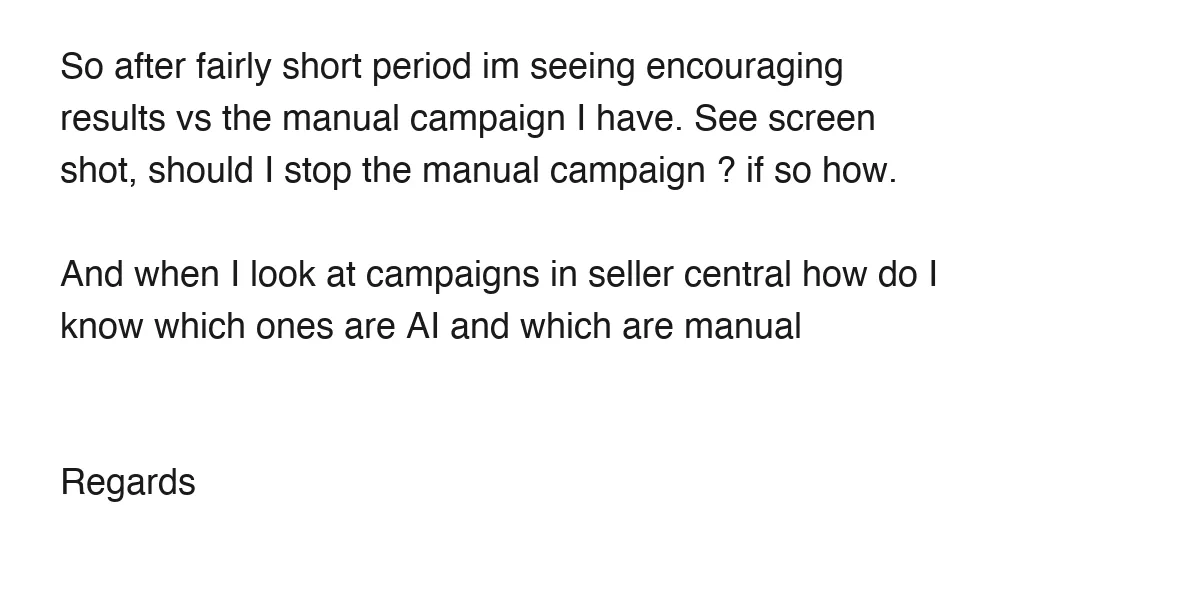
This is not a planted testimonial. This is the kind of email we get regularly. And the two questions in it tell the whole story:
Question 1: “Should I stop my manual campaign?” — The AI campaigns outperformed manual ones in a short period. Same account, same products. The seller ran both side by side and saw the difference in their own dashboard.
Question 2: “How do I know which ones are AI and which are manual?” — This is the best compliment a PPC tool can get. It means DaniksAI campaigns look and behave exactly like real campaigns. They sit in the same Campaign Manager, same reports, same bulk sheets. There is no black box, no separate dashboard. Just campaigns that happen to perform better because an AI agent manages them.
Why sellers stop managing PPC manually
I have been selling on Amazon since 2018. I run campaigns on Amazon.com and Amazon.de. I have launched products, built a brand (Daniks cookware), and watched that brand reach Top-1 in Germany and Top-20 in the USA. Through all of that, PPC was always the task that consumed the most time per dollar of return.
Here is why manual PPC management does not scale:
The data moves faster than you do. Amazon’s auction changes every hour. A keyword that cost you $0.80 per click on Monday might cost $1.40 by Wednesday because a competitor launched a lightning deal. By the time you pull a report, analyze it, make changes, and upload them — the landscape has already shifted.
Keyword discovery is never-ending. Your auto campaigns generate hundreds of new search terms every week. Most sellers check once a month, maybe. That means weeks of wasted spend on irrelevant terms and weeks of missed opportunity on converting ones.
Bid optimization is a full-time job. With 20 SKUs and three campaign types each, you are managing 60+ campaigns. Each one has dozens of keywords. Each keyword needs its bid evaluated against its current performance. That is thousands of individual decisions per week. No seller does this well by hand.
Emotions get in the way. You bid too high on the keyword you are emotionally attached to. You pause a campaign too early because one bad week spooked you. You ignore the low-volume keyword that was quietly converting at 8% ACoS because it only had 15 clicks. The AI has no emotions. It just follows the data.
How DaniksAI works in practice
Here is what happens when you connect your Amazon account to DaniksAI:
-
You set a target ACoS for each product. This is your one input. If you want 25% ACoS, the system optimizes toward 25%. If you want 15%, it optimizes toward 15%. Different products can have different targets.
-
The AI agent creates campaigns. It builds Sponsored Products campaigns with the structure and targeting it determines will perform best for your specific product and category. These appear in your Seller Central Campaign Manager just like any campaign you would create yourself.
-
It discovers keywords automatically. The agent analyzes search term data, identifies converting queries, and adds them as targets. It also identifies negative keywords — terms that cost money but do not convert — and negates them.
-
It adjusts bids continuously. Not once a week. Not once a day. The agent evaluates performance data and adjusts bids to keep your actual ACoS aligned with your target. When a keyword is winning, bids go up. When it is losing, bids go down. When it is dead weight, it gets paused.
-
You look at the results. That is it. Open Campaign Manager, check your ACoS, check your spend, check your sales. The numbers are where you told them to be.
DaniksAI vs. manual PPC: a real comparison
Here is what changes when you switch from manual management to DaniksAI:
| Manual PPC | DaniksAI Autopilot | |
|---|---|---|
| Time per week | 4–8 hours | Under 15 minutes (just reviewing) |
| Bid adjustments | Weekly, maybe | Continuous |
| Keyword discovery | Monthly STR pull | Automatic, ongoing |
| Negative keywords | When you remember | Automatic |
| Emotional decisions | Constant | None |
| Campaign structure | Whatever you built | AI-optimized |
| Scales with SKUs | Barely | Linearly |
The seller who emailed us was running both at the same time. Same products, same account. After a short period the AI campaigns were outperforming. That is not an anomaly. That is what happens when an agent that never sleeps, never gets distracted, and processes data faster than any human competes against someone with a spreadsheet and Sunday-night motivation.
Who built DaniksAI and why it matters
Most Amazon PPC tools are built by software companies that have never sold a physical product on Amazon. They hire “Amazon experts” as consultants and build what sounds good in a demo.
DaniksAI was built by Ekaterina Rubtcova — an Amazon seller since 2018, owner of the Daniks cookware brand, and the person behind the @AmazonFBAGirl YouTube channel. She built the system to manage PPC for her own products first. The same AI agent that runs on DaniksAI today is the one that managed the campaigns behind Daniks reaching the #1 bestseller position in Germany and the Top-20 in the USA.
Before Amazon, she worked at large IT companies. That engineering background is why DaniksAI is an AI agent, not a rules engine. She built what she actually needed as a seller, not what would look good in a pitch deck.
Today DaniksAI manages PPC for hundreds of Amazon brands. No course attached. No coaching upsell. Just a tool that does the work.
Common questions about DaniksAI
Does it work on Amazon.de, Amazon.co.uk, and other marketplaces? Yes. DaniksAI supports multiple Amazon marketplaces. The AI agent adapts to each marketplace’s dynamics — different languages, different competition, different bid landscapes.
How do I tell AI campaigns from my existing manual ones? DaniksAI campaigns follow a specific naming convention in Campaign Manager. They sit alongside your other campaigns with the same metrics and reporting. You can easily tell them apart by the campaign name prefix.
Should I pause my manual campaigns when I start using DaniksAI? Do not delete them — pause instead, so you preserve the data. Let the AI campaigns run for two to three weeks, then compare. Check for keyword overlap: if both are bidding on the same terms, they are competing against each other in the auction, which drives CPC up.
What if I want to keep control over specific campaigns? DaniksAI manages what you tell it to manage. You can keep manual campaigns running alongside it. Most sellers start with a few products, see the results, and then hand over the rest.
How much does it cost? Check daniks.ai for current pricing. The math is simple: if DaniksAI saves you five hours a week and keeps your ACoS at target, the tool pays for itself many times over.
The bottom line
I managed Amazon PPC manually for years. I was decent at it. I understood match types, bid strategies, campaign structures, negative keywords, dayparting, and placement optimization. I still could not compete with an AI agent that processes data faster, reacts in real time, never forgets to negate a wasted keyword, and never lets emotion influence a bid.
The email at the top of this article is what happens every time a seller runs DaniksAI alongside their manual campaigns. The AI wins. Not because the seller was bad at PPC — because PPC is a data-processing task, and AI is better at data processing than humans.
If you are still spending your Sunday nights in bulk sheets, try DaniksAI. Your time is worth more than your bid adjustments.

Ekaterina Rubtcova
Amazon seller since 2018 · Founder of Daniks cookware · Founder of Daniks.AI
My Daniks cookware reached Top-1 in Germany and is currently Top-20 in the USA. To run its PPC I built Daniks.AI — now used by hundreds of Amazon brands. On this blog I share how I actually operate, no courses, no upsells.
Subscribe to our YouTube channel
Subscribe to our YouTube channel for video walkthroughs
Subscribe NowRelated articles

Daniks.AI vs Manual Amazon PPC: NordFrost Case Study
Amazon PPC weekly report: Daniks.AI delivers 7.77x ROAS at 12.9% ACoS on NordFrost drinkware. $0.39 CPC, 149 orders, TACoS 8.1%.
Daniks.AI vs Manual Amazon PPC: StellaHive Case Study
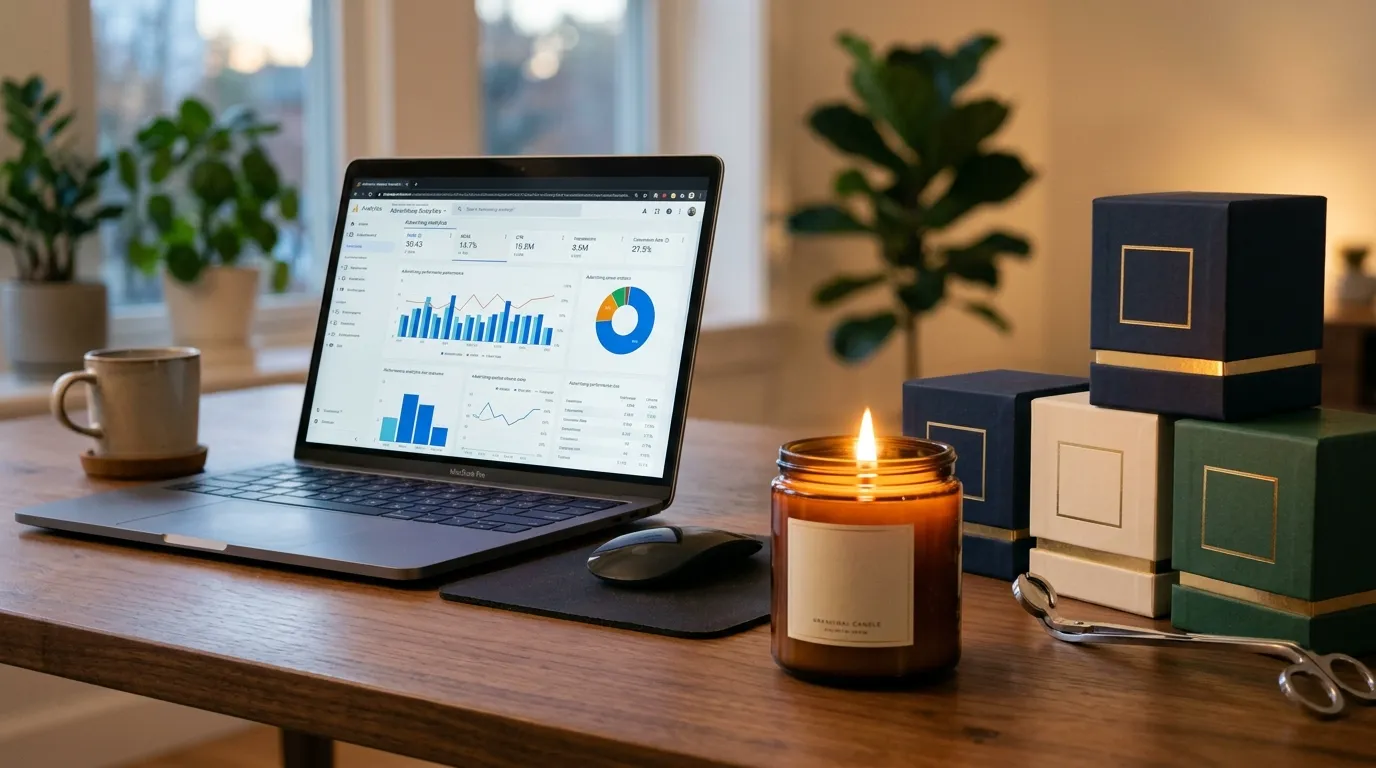
Amazon PPC case study: Daniks.AI vs manual on StellaHive candles. 6.2 vs 3.5 ROAS, 16% vs 28% ACoS, 34% cheaper clicks over 6 weeks.
Amazon ACoS Explained: What It Is and How to Lower It
Learn what Amazon ACoS means, how to calculate it, good ACoS benchmarks by category, and proven tactics to lower your advertising cost of sale in 2026.