Amazon FBA Import from China — Step-by-Step Guide 2026
Most Amazon FBA sellers source from China. The process sounds complicated — customs duties, import VAT, Incoterms, EORI, freight forwarders — but it is manageable once you understand the steps. This is the guide I wish I had when I ordered my first container for Daniks back in 2019.
The examples below use EU/Germany specifics because that is where I import, but the overall process — samples, Incoterms, freight, customs classification, prep — applies to every major Amazon marketplace. Where a step is EU-specific, I call it out so you can substitute your own country’s requirements.
Before you import: three prerequisites
1. EORI number (EU) or equivalent importer ID
In the EU, no EORI number means no import. Application takes 1-3 weeks through your national customs authority and costs nothing. If you sell on Amazon.com instead, you need a U.S. Customs Bond and an importer of record (IOR) — your freight forwarder can usually set this up. For the UK, you need a separate UK EORI post-Brexit.
2. VAT or sales-tax registration
In the EU, you need a VAT identification number to reclaim import VAT. In the U.S., you need a sales-tax permit for the states where you have nexus. Make sure your tax registration is sorted before the first shipment lands.
3. Business entity in place
LLC, sole proprietorship, GmbH, or whatever structure fits your country — get it done before you invest $5,000+ in inventory. Mixing personal and business finances creates headaches at tax time and limits your liability protection.
The import process step by step
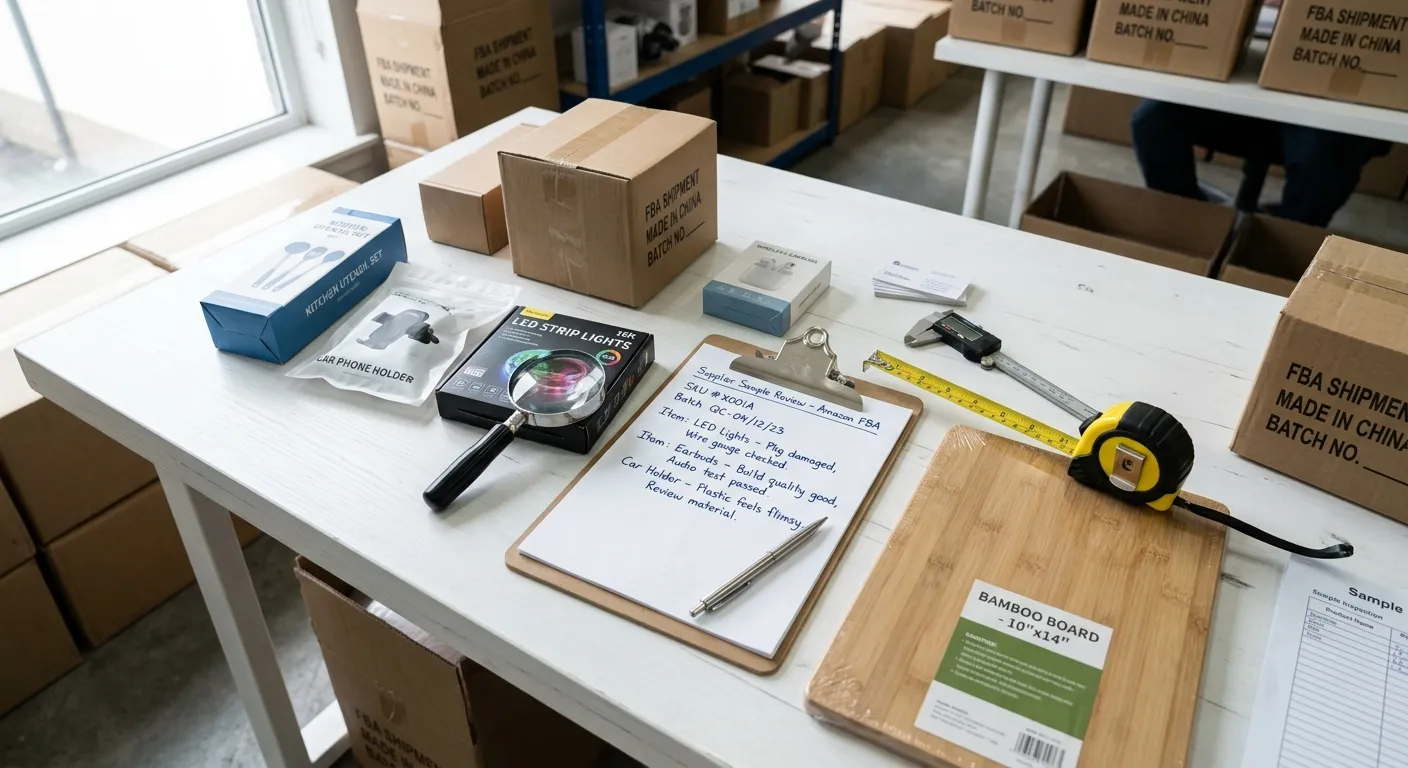
Step 1: Order and inspect samples
Before placing a bulk order: order 2-3 samples from different suppliers. Via express shipping (DHL, FedEx, UPS) this takes 5-7 days and costs $30-80 per sample including shipping.
Check:
- Build quality against your specification sheet
- Packaging — does it fit within your target FBA size tier?
- Certifications — does the product actually carry what the supplier claims?
Step 2: Understand and negotiate Incoterms
Incoterms define who pays for what and who bears the risk during transport. The three that matter for FBA imports:
FOB (Free on Board) — the standard for most FBA sellers:
- Supplier covers costs to the port in China (inland transport, export customs, loading)
- From the moment goods are on the vessel, you are responsible (ocean freight, insurance, import duties, inland transport)
- Recommendation: FOB is the right choice for 90% of orders
EXW (Ex Works) — the cheapest unit price, but you handle everything:
- You pick up goods at the factory gate
- You arrange inland transport in China, export clearance, the lot
- Only makes sense if you have an experienced forwarder with a China office
DDP (Delivered Duty Paid) — the supplier delivers to your door, duties included:
- Sounds convenient, but it is more expensive and you have less control
- Customs paperwork runs through the supplier — if something goes wrong, you have no access
- Only makes sense for very small quantities or when the supplier routinely ships DDP to your country
Step 3: Find a freight forwarder
A good freight forwarder is the most important partner in the import process. They handle:
- Pickup from the supplier (for FOB: arrangement from the port in China)
- Ocean freight or air freight
- Customs clearance at destination
- Delivery to the FBA warehouse or your prep center
Where to find one: Flexport, Freightos, and Forceget are well-known platforms for quotes. Alternatively, local forwarders via recommendations from seller communities. I now use a mid-size forwarder from Hamburg that another seller recommended — his flat fee for customs clearance is EUR 75 per shipment.
Get at least 3 quotes. Price differences on ocean freight are often 20-40% for the exact same service.
Step 4: Choose your shipping method
Ocean freight (sea freight):
- Transit time: 30-45 days (China to major EU/US ports)
- Cost: roughly $2.50-5.00 per kg (depending on volume and current rates)
- Makes sense from: 2+ CBM (cubic meters) or 200+ kg
- Options: FCL (full container load, 20’ or 40’) or LCL (less than container load, shared with other shipments)
Air freight:
- Transit time: 7-12 days
- Cost: roughly $5.00-10.00 per kg
- Makes sense for: small, lightweight products or urgent restocks
Express (DHL/FedEx/UPS):
- Transit time: 3-7 days
- Cost: roughly $8.00-15.00 per kg
- Makes sense for: samples, first shipments under 50 kg, emergency restocks
My rule of thumb from Daniks: First order via air freight (faster, manageable quantities, less risk). From the second order onward, switch to ocean freight — the cost savings justify the longer wait.
Step 5: Customs duties and import taxes
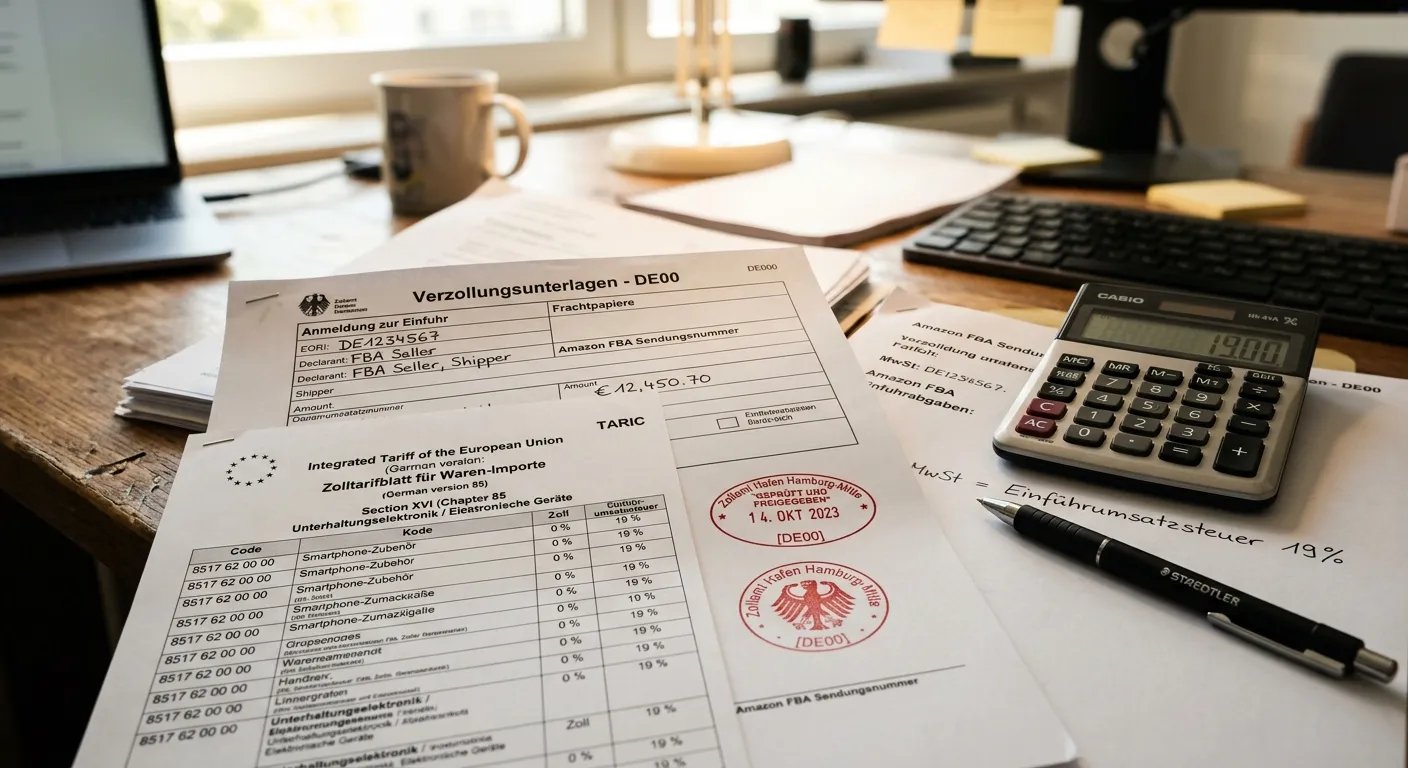
When your goods arrive at the destination port, two costs apply:
Import duty:
- Depends on the product classification (HS code / tariff code)
- Typical for consumer goods: 0-12% on the customs value (CIF = product value + freight + insurance)
- Look up your HS code in your country’s tariff database (the EU TARIC portal for Europe, the USITC HTS for the U.S.)
- Example: stainless-steel kitchen utensils, HS 7323, duty rate 3.5% in the EU
Import VAT (or equivalent):
- In the EU: 19% (Germany) or your country’s VAT rate on the total value (product value + freight + duty)
- In the U.S.: no federal import VAT, but you still owe state sales tax where you have nexus
- In the EU, import VAT is reclaimable as input tax on your VAT return — it is a cash-flow item, not a real cost. But you have to pre-finance it
- Example (EU): EUR 5,000 product value + EUR 300 freight + EUR 185 duty = EUR 5,485. Import VAT at 19% = EUR 1,042
Important: the VAT pre-financing catches beginners off guard. On a EUR 10,000 order you need to front roughly EUR 2,100 in import VAT that you only get back with your next VAT return (1-3 months later).
Step 6: Prep and inbound to the FBA warehouse
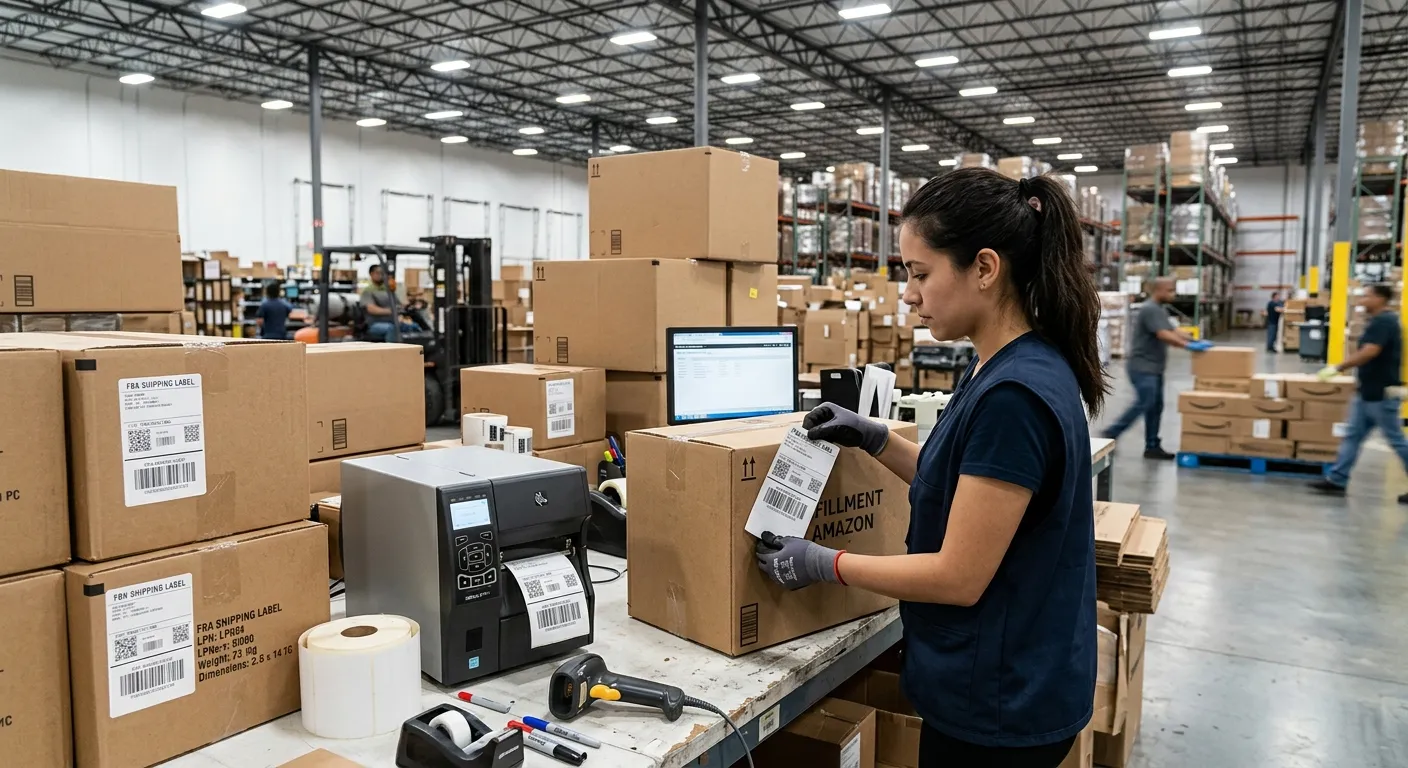
Your goods arrive at the forwarder’s warehouse or your prep center. Here is what happens:
- FBA labeling (FNSKU labels on every unit)
- Packaging check — do the dimensions match your target size tier?
- Quality control — spot-check at least 10% of units
- Create shipment in Seller Central and print shipping labels
- Ship to FBA warehouse — ideally split across 4-6 warehouses to minimize Inbound Placement Fees
The most common import mistakes
Mistake 1: Wrong tariff classification
A wrong HS code can mean you pay too much or too little duty. Paying too little sounds great — until customs runs an audit and you owe back-payments plus penalties. Have your forwarder confirm the code and double-check it yourself in the official tariff database.
Mistake 2: No product certification before ordering
CE marking, GPSR responsible person designation, WEEE registration (EU) — depending on the product category, you need these before importing. If your goods arrive at customs without the required CE marking, they get held at best and destroyed at worst. More on this in the GPSR compliance article. For U.S. imports, check CPSC, FCC, or FDA requirements depending on your product category.
Mistake 3: No cargo insurance
Ocean freight is cheap, but a container can be lost, damaged, or stuck at port. Transport insurance typically costs 0.5-1.5% of the product value. On a $10,000 order that is $50-150. Without insurance, you bear the full loss.
Mistake 4: Not budgeting for import-tax pre-financing
As described above: in the EU, 19% import VAT on the total value must be fronted. If you have not planned for this in your cash flow, you suddenly lack liquidity for PPC or your next order.
Realistic cost breakdown: first order
| Item | Cost (example: 500 units, 5 kg each) |
|---|---|
| Product value (FOB) | $5,500 |
| Ocean freight (LCL) | $650 |
| Cargo insurance | $65 |
| Import duty (3.5%) | $217 |
| Import VAT (19%, EU example) | $1,222 (reclaimable) |
| Forwarder handling fee | $80-165 |
| Prep center | $220-440 |
| Total cash out | ~$7,950-$8,260 |
| Reclaimable (import VAT) | ~$1,222 |
| Effective cost | ~$6,730-$7,040 |
Per unit: roughly $13.50-14.10 effective cost to the FBA warehouse. This is the number that belongs in your true-COGS calculation.
Timeline: how long does the first import take?
| Phase | Duration |
|---|---|
| Order and inspect samples | 2-3 weeks |
| Place bulk order | 15-30 days production |
| Ocean freight (China to destination) | 30-45 days |
| Customs clearance | 2-5 days |
| Prep and FBA inbound | 5-10 days |
| Total | ~10-15 weeks |
Plan realistically. Many beginners expect 6 weeks and get frustrated when it takes 12. Better to plan conservatively and be pleasantly surprised.
Next steps
- Get your EORI number (EU) or customs bond (U.S.) — if you do not have one yet
- Request freight-forwarder quotes — compare at least 3
- Research the HS code for your product
- Check product safety and certification requirements — before you place the order
For the full picture of all FBA startup costs, read the Amazon FBA Startup Cost 2026 article.
Questions about the import process? Reach me through the contact form.

Ekaterina Rubtcova
Amazon seller since 2018 · Founder of Daniks cookware · Founder of Daniks.AI
My Daniks cookware reached Top-1 in Germany and is currently Top-20 in the USA. To run its PPC I built Daniks.AI — now used by hundreds of Amazon brands. On this blog I share how I actually operate, no courses, no upsells.
Subscribe to our YouTube channel
Subscribe to our YouTube channel for video walkthroughs
Subscribe NowRelated articles
Amazon FBA Inventory Management: Avoid Fees and Stock Smarter
Master Amazon FBA inventory management with restock timing, IPI score optimization, and tactics to avoid long-term storage fees in 2026.
Reduce Your Amazon FBA Return Rate: What Actually Works
Lower your Amazon FBA return rate with 8 proven tactics — from listing photos to packaging. With real numbers from my own products.

Pan-EU vs EFN vs NARF: Which EU Program Is Worth It?
Amazon Pan-EU, EFN, and NARF compared — costs, delivery times, VAT obligations, and which program makes sense for your business in 2026.