AI vs Agency Amazon PPC: Basecamp Roasters Case Study
A coffee brand on Amazon US ran two PPC tracks in parallel for a full month: Daniks.AI on autopilot and a paid agency managing campaigns manually. Both tracks got nearly identical impressions — around 300K each. The AI side returned 2.4 ROAS at 42% ACoS. The agency side returned 1.3 ROAS at 77.7% ACoS. Same brand, same month, same marketplace, and a gap wide enough that one side was building margin while the other was burning it.
Ownership disclosure. I am the founder of Daniks.AI, the AI-native Amazon PPC automation that managed the auto side of this test. I built it for my own listings first — the Daniks cookware brand that reached Top-1 in Germany and is now Top-20 in the USA. Basecamp Roasters is a customer brand running on Daniks.AI, not my brand. They sell specialty coffee on Amazon US and ran the AI and agency tracks simultaneously on their own seller account. The dashboard data below is published with their permission.
What was tested
The setup was clean: one Amazon US seller account, one coffee brand portfolio, two parallel PPC tracks running for a full calendar month in 2026.
- Track A (Auto): Daniks.AI managing Sponsored Products end-to-end — campaign creation, keyword harvesting, bid adjustments, negative keyword management, and target-ACoS optimization. The AI agent ran on autopilot with a fixed ACoS target.
- Track B (Agency): a paid PPC agency managing parallel Sponsored Products campaigns on the same product catalog. Manual bid adjustments, keyword research, search-term report analysis, placement modifiers — the standard agency playbook.
This is not a “beginner vs AI” comparison. The agency side was a professional PPC service the brand was paying for. Both tracks had comparable budgets and pulled from the same ad inventory on the same marketplace.
What makes this comparison unusually clean: both sides received nearly identical impressions. The auto side got 301K impressions; the agency side got 307K. When impression volume is this close, the efficiency gap cannot be explained by one side simply having more budget or more exposure. The difference is what each side did with those impressions.
Key Takeaways
- On equal impressions (~300K each), Daniks.AI delivered 2.4 ROAS vs the agency’s 1.3 ROAS — an 85% efficiency advantage.
- ACoS dropped from 77.7% to 42.0%, a 35.7 percentage-point reduction. The agency side was losing money on every ad dollar; the AI side was in the profitable band.
- CPC was 24% cheaper ($1.02 vs $1.34) — the AI bought clicks for a dollar while the agency paid $1.34 for the same marketplace.
- 46% more orders (229 vs 157) and 51% more revenue ($3,808 vs $2,529) from fewer ad dollars.
- The auto side spent $365 less ($1,601 vs $1,966) and generated $1,279 more in sales. The combined swing is $1,644 in a single month.
The headline numbers
The dashboard view from the Daniks.AI Amazon App, full month, 2026:
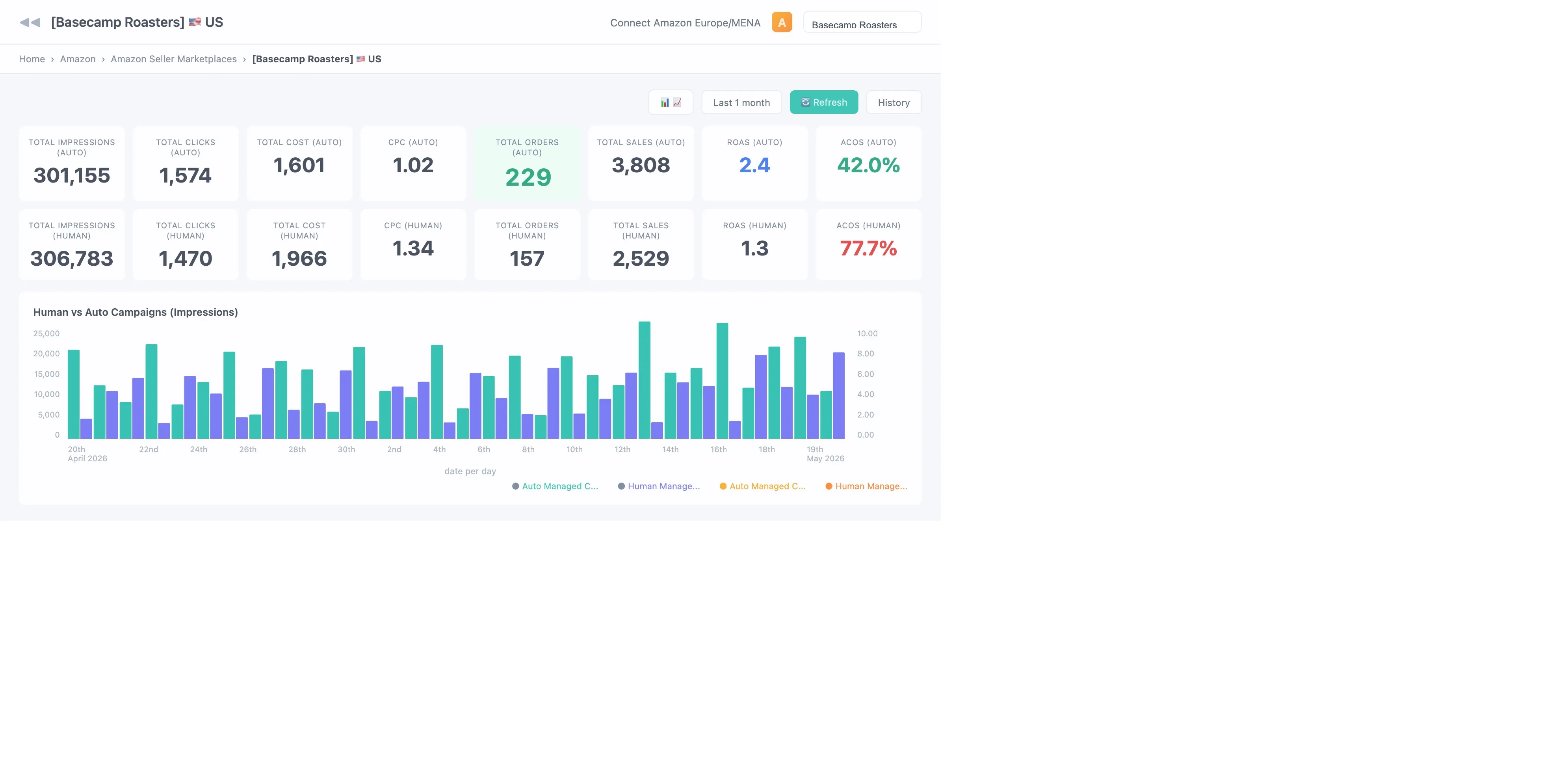
| Metric | Daniks.AI (Auto) | Agency (Human) | Edge |
|---|---|---|---|
| Impressions | 301,155 | 306,783 | Roughly equal |
| Clicks | 1,574 | 1,470 | Auto +7% |
| Spend | $1,601 | $1,966 | Auto -19% |
| CPC | $1.02 | $1.34 | Auto -24% |
| Orders | 229 | 157 | Auto +46% |
| Sales | $3,808 | $2,529 | Auto +51% |
| ROAS | 2.4 | 1.3 | Auto +85% |
| ACoS | 42.0% | 77.7% | Auto -35.7 pp |
Three things jump out immediately. First, the impression counts are nearly identical — this is a true apples-to-apples comparison on exposure. Second, the AI side won on every efficiency metric, not just volume. Third, a 77.7% ACoS from a paid agency means the brand was paying the agency fee on top of already-unprofitable ad spend. The actual loss was worse than the dashboard shows.
Click economics: 24% cheaper and 36% more productive
The auto side paid $1.02 per click while the agency paid $1.34 — a 24% gap. On roughly 1,500 clicks each, that difference alone accounts for the $365 in spend savings.
But CPC only tells half the story. What matters more is what happened after the click.
- Auto CVR: 229 orders / 1,574 clicks = 14.5%
- Agency CVR: 157 orders / 1,470 clicks = 10.7%
The AI side converted clicks to orders at 36% higher rate. In a consumable category like coffee — where repeat buyers and subscription customers drive purchase velocity — this gap reflects better keyword targeting, not better listings. Both tracks sent traffic to the same product pages. The difference is which search terms generated those clicks.
When an AI agent harvests converting search terms into exact-match campaigns and negates non-converters on a continuous loop, the click inventory tightens quickly. An agency running the same process on a weekly or biweekly cadence falls behind because the auction moves daily. By the time the agency has cleaned up last week’s search-term report, the AI side has already redirected spend toward the keywords converting this morning.
The compounding effect: 24% cheaper clicks × 36% higher CVR = 69% better return per ad dollar. That is what shows up in the ROAS gap.
ACoS: the difference between profit and loss
Two numbers, one story:
- ACoS dropped from 77.7% to 42.0%, a 35.7 percentage-point reduction.
- ROAS rose from 1.3 to 2.4, an 85% improvement.
A 77.7% ACoS on a coffee brand — after referral fees, fulfillment fees, and the cost of the beans — means the agency-managed campaigns were losing money on every sale they generated. The brand was paying for ads, paying the agency, and getting back less than it spent. That is not a growth strategy; it is a subsidy for Amazon’s ad platform.
A 42% ACoS on the same brand sits in the band where most operators can sustain and scale. For a consumable product with repeat purchase behavior, PPC at this ACoS is buying customer acquisition that pays back over three to four reorders. The AI side was building the customer base; the agency side was depleting the ad budget.
The dollar gap makes this concrete: the auto side spent $1,601 and generated $3,808 in sales. The agency side spent $1,966 and generated $2,529. The AI made $2,207 in gross ad-attributed margin. The agency lost $437 before their management fee.
Why equal impressions make this case study different
Most AI-vs-manual PPC comparisons have a budget imbalance. The AI side gets more spend because it is hitting its ACoS target, so the brand routes more money to it. That makes efficiency comparisons valid but raises the question: would the manual side do better with equal budget?
This case study answers that question. Both tracks received approximately 300K impressions — the agency actually got slightly more (306K vs 301K). The brand did not starve the agency of budget. The agency had every opportunity to match the AI’s performance and simply did not, because the gap is not about money. It is about reaction speed.
An AI agent adjusts bids, harvests keywords, and negates losers on a near-continuous cycle. A human team, no matter how skilled, operates on a cadence — weekly reviews, biweekly optimizations, monthly strategy calls. In a category like coffee where conversion patterns shift with Prime deals, subscribe-and-save cycles, and seasonal demand, a weekly cadence leaves money on the table every day between reviews.
Honest caveats
This is one brand, one month, one category. Four things to read before drawing universal conclusions:
1. Single brand, single month. Coffee is a high-CVR consumable category with repeat buyers. The AI’s advantage in keyword harvesting speed may be larger here than in a low-frequency, high-consideration category like furniture. Treat this as one data point.
2. Agency skill is variable. “A paid agency” is not a universal benchmark. Some agencies run exceptional PPC. The agency in this test delivered a 77.7% ACoS, which suggests they were not among the top tier — or they were in an early optimization phase. A different agency might have closed more of the gap.
3. No isolation between tracks. Both tracks ran on different campaign sets within the same account. The AI-driven impressions may have boosted branded search volume that the agency campaigns benefited from. The true standalone gap for the agency, without the AI running alongside it, might have been even worse.
4. I built the tool. I am not a neutral observer. I founded Daniks.AI, and I am publishing this case study because the numbers are strong. You should weight that accordingly and run your own parallel test before making a decision.
What this means if you are paying an agency
The uncomfortable math: if your agency is delivering ACoS above 60% on a mature product catalog, you are probably paying twice — once for the ad spend that is not returning, and once for the management fee on top of it.
Questions to ask your agency this week:
- What is your search-term report review cadence? If the answer is “weekly” or “biweekly,” you are leaving 5-7 days of unoptimized spend on the table between each cycle.
- How many negative keywords did you add last month? An aggressive negative keyword strategy is the fastest path to CPC reduction. If the number is under 50, the cleanup is not happening.
- What is your CVR by match type? If exact-match CVR is not meaningfully higher than broad-match CVR, keyword harvesting is not working.
If the answers are unsatisfying, run a parallel two-week test. Keep your agency campaigns running on one track, put an AI tool on autopilot on a separate campaign set, and compare CPC, CVR, and ACoS daily. The pattern will be visible by day 10.
Where agencies still add value
The point of this case study is not “fire your agency.” Agencies do things that no AI agent can:
- Strategic calendar planning. Prime Day prep, seasonal pushes, coupon stacking, Lightning Deal coordination — these require human judgment about when to change the rules.
- Creative and listing optimization. An agency that also handles your A+ Content, main image testing, and title optimization is adding value that shows up in CVR across all traffic, not just PPC traffic.
- Cross-channel coordination. If your agency manages TikTok, Google Ads, and Amazon together, the attribution and budget allocation across channels is a human strategy problem.
- Launch playbooks. New ASINs with zero conversion history need a human-designed campaign structure for the first 14 days before an AI agent has enough data to optimize.
The pattern I see working: let the AI run the daily bid math and keyword harvesting, let the human run the strategic overlay and creative optimization. The agency becomes a strategist, not a bid jockey.
Frequently asked questions
Is 42% ACoS good for Amazon PPC?
It depends on your margin. For a coffee brand with healthy gross margins and repeat-purchase behavior, 42% ACoS is sustainable because customer lifetime value exceeds the acquisition cost. For a thin-margin product with no repeat purchases, you would want ACoS below 25-30%. The agency’s 77.7% ACoS is unprofitable in virtually any category.
How does Daniks.AI achieve lower CPC than a human agency?
The AI adjusts bids on a near-continuous loop based on live auction signals, time-of-day patterns, and recent conversion data. A human agency reviews bids on a weekly or biweekly cadence. Between reviews, some keywords get overbid and some get underbid. The CPC you pay is the average of those drift periods. The AI eliminates the drift.
Can I run Daniks.AI and my agency at the same time?
Yes. This case study is exactly that setup. Create a separate campaign set for the AI to manage, leave your agency campaigns running, and compare. Halo effects exist — branded search benefits from total impression volume — but per-campaign metrics remain attributable.
How long does it take to see results from an AI PPC tool?
In my experience across hundreds of brands, the AI stabilizes in two to three weeks once it has clean conversion data. The first week is data collection. By week two, keyword harvesting and negative matching are running. By week three, the ACoS gap against manual management is usually visible in your dashboard.
What if my agency is already delivering good ACoS?
If your agency delivers ACoS in the 20-35% range consistently, the gap from switching to AI will be smaller — probably a 10-20% ROAS improvement rather than the 85% shown here. The bigger the current inefficiency, the bigger the AI advantage.
What to do this week
If you are spending $3K+/month on Amazon PPC through an agency and your ACoS is north of 50%, you are likely losing money on every ad dollar. Run a parallel two-week test: keep the agency campaigns running, set up a separate campaign set on Daniks.AI or any AI PPC tool you can trial, and track daily ACoS, CPC, and CVR side by side. By day 14, your own dashboard will tell you whether the gap is real for your brand.
For the full walkthrough of how I evaluate PPC performance across my own brands, subscribe to @AmazonFBAGirl on YouTube. I break down real dashboards, real numbers, and real mistakes — no theory, no hype.

Ekaterina Rubtcova
Amazon seller since 2018 · Founder of Daniks cookware · Founder of Daniks.AI
My Daniks cookware reached Top-1 in Germany and is currently Top-20 in the USA. To run its PPC I built Daniks.AI — now used by hundreds of Amazon brands. On this blog I share how I actually operate, no courses, no upsells.
Subscribe to our YouTube channel
Subscribe to our YouTube channel for video walkthroughs
Subscribe NowRelated articles
Daniks.AI vs Teikametrics 2026: Honest PPC Comparison
Daniks.AI vs Teikametrics: pricing, automation, features. Which Amazon PPC tool fits — AI autopilot or enterprise optimization platform?
Amazon PPC for Beginners: ACOS, Ads & What to Know
Amazon PPC for beginners: ad types, ACoS vs TACoS, match types, keyword funnel, and the agency red flag most sellers miss. A 2026 guide.

AI vs Manual Amazon PPC: A Real Case Study (Tropeza, 2024)
Side-by-side Amazon PPC case study from August 2024, Daniks.AI auto vs manual on the Tropeza artificial plants brand: ACoS, RoAS, CPC, CVR compared.